Welcome to MTC E-Waste Recycling
India’s Critical Mineral Mission: Securing the Minerals of Tomorrow
An executive summary of India’s National Critical Minerals Mission.
The National Critical Mineral Mission (NCMM), launched by the Ministry of Mines, seeks to secure India’s long-term supply of critical minerals vital for clean energy, advanced technologies, and industrial growth. It responds to global supply chain risks exposed by China’s export restrictions and the Russia-Ukraine war. Covering FY 2024–31, the mission focuses on seven pillars: boosting domestic exploration and mining (1,200 projects, offshore mining, block auctions), acquiring overseas mineral assets through PSUs and private players, incentivizing recycling with new guidelines, strengthening trade agreements and national stockpiles, promoting R&D and patents, building a skilled workforce, and creating fiscal incentives to attract investment.
International cooperation is a key element, with India engaging in frameworks like the Mineral Security Partnership (MSP), iCET, IPEF, Quad, and bilateral MoUs with countries such as Argentina and Australia. The mission will be governed by an empowered committee chaired by the Cabinet Secretary. By 2030–31, its ambitious targets include 1,200 exploration projects, 26 overseas mines by PSUs, 24 by private entities, 400 kt of recycled materials, 1,000 patents in the value chain, 10,000 trained professionals, and multiple mineral processing parks and stockpiles.
The original file can be found on Ministry of Mine’s website, here:
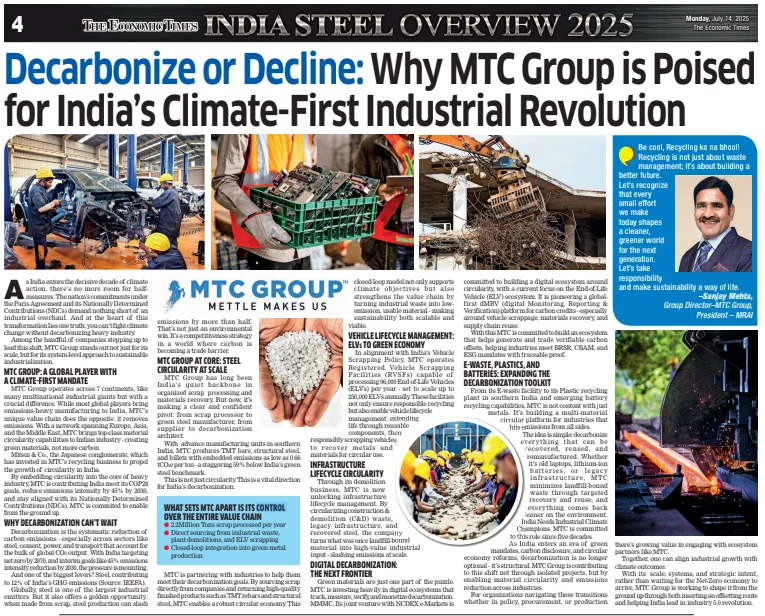
https://mines.gov.in/admin/storage/ckeditor/DAY_1_PPT_4_1737542656.pdfDecarbonize or Decline: MTC Group Leads India’s Climate-First Industrial Revolution
Highlighting MTC Group’s system-level approach to circularity and green steel, with innovations spanning ELV scrappage, digital carbon credits, and multi-material recycling
E-Waste Recycling and India’s Critical Minerals Mission
An analysis of how e-waste recycling can support India’s National Critical Minerals Mission by turning discarded electronics into a domestic source of critical minerals.
India generated more than 1.6 million metric tons of e-waste in 2021, placing it among the top five countries worldwide. Less than 20% of this waste is formally collected and recycled. At the same time, India imported over 90% of its lithium and cobalt requirements, alongside more than 12,000 tons of rare earth compounds in 2022. These figures highlight the scale of both the challenge and the opportunity.
India faces two linked challenges. One is the rising mountain of electronic waste. The other is the urgent need for critical minerals such as cobalt, nickel, lithium, and rare earth elements. These minerals are vital for electric vehicles, renewable energy, electronics, and defense. The National Critical Minerals Mission (NCMM) aims to secure these resources for the country. E-waste recycling can play a central role in this effort.
E-waste is more than discarded gadgets. It contains copper, aluminum, gold, silver, and critical minerals hidden in circuit boards, batteries, and magnets. Unlike traditional mining, these materials are already concentrated. Recovering them reduces the need for imports and lessens the impact on the environment. In this sense, e-waste is India’s urban mine.
The scale is growing. India already recycles 7,500 metric tons of e-waste every year, with plans to increase this capacity to 40,000 metric tons. Battery recycling, another vital link, is also expanding. These facilities can supply the minerals needed for EV batteries, solar cells, and defense alloys. By aligning recycling with NCMM, India can build a domestic loop for critical materials.
Recycling also reduces risks linked to global supply chains. Today, rare earth elements are heavily controlled by China, and cobalt comes largely from the Democratic Republic of Congo. Both sources come with geopolitical risks. Depending too much on imports makes India vulnerable. By recovering metals from e-waste, India gains more independence and security.
There is another benefit: carbon savings. Mining and refining critical minerals consume large amounts of energy. Recycling reduces this energy use and lowers carbon emissions. Companies can track these benefits using digital traceability tools. Systems that log every step of recovery – using QR codes, weight checks, and mass balancing – build trust that recycled materials meet quality and compliance standards. These systems can also generate audit-ready data for carbon accounting.
For industries, this means access to a reliable and traceable supply of critical minerals. For the country, it means fewer imports, lower emissions, and stronger supply security. For society, it means less waste in landfills and better use of resources. Linking e-waste recycling with the Critical Minerals Mission an environmental, industrial, and strategic upside.
India’s path forward lies in scaling this model. Urban mining hubs that handle e-waste, batteries, and plastics can be set up across major cities. These hubs can recover and channel materials into steel, copper, and alloy plants. They can feed into EV and electronics supply chains. They can also support defense and aerospace needs where secure mineral sourcing is critical.
The NCMM gives a policy framework. Recycling provides the material flow. Together, they can create a resilient system for critical minerals. Instead of seeing e-waste as a burden, India can treat it as a resource. This shift can help the country move closer to self-reliance while also reducing its environmental footprint.
In short, the solution is in front of us. Mine less, recycle more. Connect e-waste recovery with the Critical Minerals Mission. Build security and sustainability at the same time.
India’s Critical Mineral Mission: Securing the Minerals of Tomorrow
An executive summary of India’s National Critical Minerals Mission.
The National Critical Mineral Mission (NCMM), launched by the Ministry of Mines, seeks to secure India’s long-term supply of critical minerals vital for clean energy, advanced technologies, and industrial growth. It responds to global supply chain risks exposed by China’s export restrictions and the Russia-Ukraine war. Covering FY 2024–31, the mission focuses on seven pillars: boosting domestic exploration and mining (1,200 projects, offshore mining, block auctions), acquiring overseas mineral assets through PSUs and private players, incentivizing recycling with new guidelines, strengthening trade agreements and national stockpiles, promoting R&D and patents, building a skilled workforce, and creating fiscal incentives to attract investment.
International cooperation is a key element, with India engaging in frameworks like the Mineral Security Partnership (MSP), iCET, IPEF, Quad, and bilateral MoUs with countries such as Argentina and Australia. The mission will be governed by an empowered committee chaired by the Cabinet Secretary. By 2030–31, its ambitious targets include 1,200 exploration projects, 26 overseas mines by PSUs, 24 by private entities, 400 kt of recycled materials, 1,000 patents in the value chain, 10,000 trained professionals, and multiple mineral processing parks and stockpiles.
The original file can be found on Ministry of Mine’s website, here:
https://mines.gov.in/admin/storage/ckeditor/DAY_1_PPT_4_1737542656.pdf